
You Can Thank Carrie Bradshaw
for Your 19$ Bagel

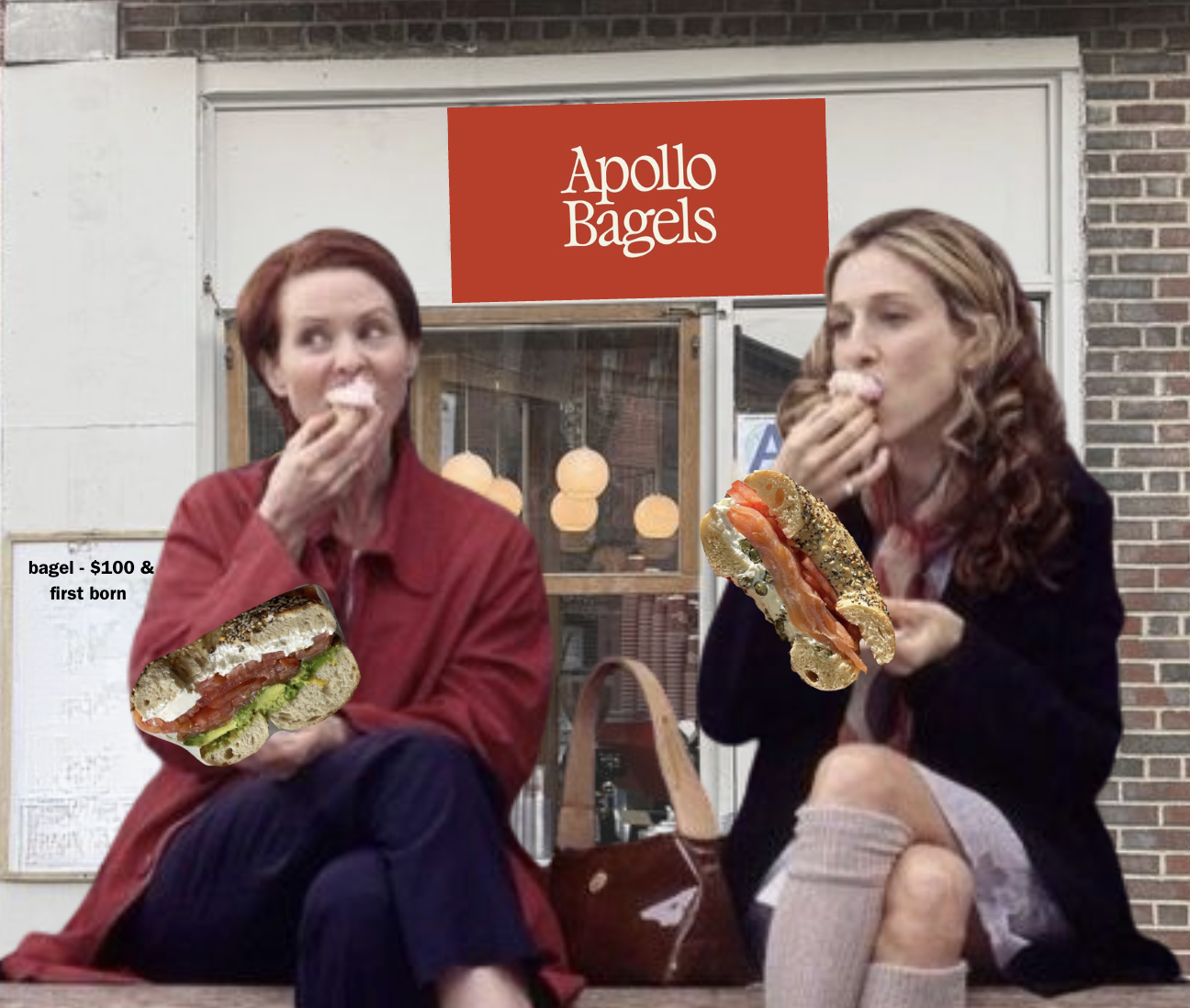
Imagine this. It’s Saturday morning and you have just spent the night at your two week old situationship’s apartment for the first time. News flash. He lives in the West Village. You wake up to a text explaining that he left well before you because he has a pickleball championship tournament and that you should help yourself to something if you are hungry.
You obviously do not. You want to remain poised. Instead, you head out to scavenge for a bagel.
You have lived in Hell’s Kitchen for three years, and it is rare that you find yourself immersed in the very specific Saturday morning culture of the West Village at ten o’clock. How exciting. Instinctively you trot outside hoping to stumble upon one of those spots TikTok insists you must run to instead of walk.
You don’t have to go far. The moment you step outside you see the very highly recommended bagel shop Apollo Bagel. Immediately a question comes to mind. What exactly does a Greek god have to do with a bagel in Manhattan? If anything it would make more sense to call the place Apollo’s Bagels if the goal is bagel notoriety.
Then you see the catch.
There is a line the size of a Sylvia Plath book signing stretching to the entrance.
Thankfully, you know better. You disengage.
You bypass the line just long enough to peek inside and read the menu, half expecting every item to contain some kind of addictive secret ingredient. Instead you discover that the shop is charging two extra dollars to add butter to your bagel. At that point the name should be changed from Apollo to Appalling. Slightly stunned, you walk one street down to a practically empty deli and pay five dollars for a bacon, egg, and cheese that hits exactly the right spot in both your stomach and your wallet.
Which leaves the question. Who exactly created this repetitive culture where it is now normal to spend an hour of a precious weekend morning waiting in line for a basic twenty dollar bagel?
Good thing her ghost lives four streets away.
The brownstone used as Carrie Bradshaw’s apartment in Sex and the City, currently occupied by someone who certainly did not sign up to become a tourist attraction, now draws crowds that rival the Empire State Building. Sex and the City has been running in one form or another since 1998, presenting a version of New York that exists in a completely different universe from shows like Friends, Seinfeld, Gossip Girl, or How I Met Your Mother.
Gossip Girl is too unattainable for most people to replicate, while the others are almost too relatable and, frankly, a little bland. Sex and the City sits comfortably in the fantasy sweet spot. The show follows four women navigating the familiar dilemmas of their thirties while promising a glamorous apartment, daily lunches, an endless rotation of handsome wealthy men, and outfits that are never worn twice. It is clearly a hyperbolized version of New York’s supposed abundance of opportunity, yet for many viewers it reads less as satire and more as inspiration, even a reason to move to the city.
Is that life possible? Technically, yes. But at what cost?
New York City is a city where anything in theory can happen. The West Village, once a foundational hub for minority liberation, the birthplace of artistic expression, and a haven for the bold and unconventional, has slowly transformed into something else entirely.
New York Magazine recently released a May issue titled It Must Be Nice to Be a West Village Girl, paired with a lengthy feature by Brock Colyar examining the neighborhood’s cultural shift. The piece sparked debate, with some readers arguing it veered into stereotype. Still, the article captured something many New Yorkers have quietly noticed. I cannot pretend to be above the phenomenon simply because I do not currently live there and spend every waking opportunity holding an iced coffee skipping down 7th Avenue. Let’s be honest. If most of us were offered an apartment on Hudson tomorrow we would sprint to sign the lease.
The article suggests that many post grad arrivals come to New York with a certain expectation. They had the SEC college experience with its built in social structure and easy freedom. Now they expect the city to bend around that same lifestyle, Ignorantly disregarding where exactly they are. The result is that the city’s famous melting pot of creativity feels like it is beginning to solidify. The word creative is slowly being crossed out and replaced with influencer. True influence has historically come from people we can call masters. Artists, writers, musicians, thinkers. We study their work. We interpret it. We add to the conversation. What we do not do is simply replicate their aesthetic. Following a TikTok trail to a four hour line for a designer sample sale or documenting which bar serves the best espresso martini in the East Village is not originality.
It is conformity dressed as discovery.
A few years ago I worked the front desk at an Equinox in the West Village, where I became friendly with several longtime members. They often laughed about how the neighborhood they had lived in for sixty five years had completely transformed. At the time I chuckled along without fully grasping the weight of what they were saying when they casually reminisced about running into Bob Dylan on a normal afternoon.
One of my favorite examples of true artistic influence is the New York artist Jean Michel Basquiat. In the 1980s he was not wandering the polished streets of the West Village. He was downtown in the Bowery which… had a different look than it does today. Basquiat pulled inspiration from real life. From books that spoke to him. From history, culture, and symbols that demanded to be placed on canvas. He combined influences until they formed something entirely new. He created space for his artistic voice by ignoring the pressure to conform. Fun fact. The final apartment Basquiat lived in before his death is now available to rent for the modest price of sixty thousand dollars per month.
Funny, right?
The irony of artists who try to imitate Basquiat today is that they copy him rather than the world he responded to. And how could they do otherwise? They have no personal connection to the material.
The same applies to the West Village and many other parts of New York. People who arrive without a connection to the culture or any intention of contributing to it inevitably end up chasing the image rather than the substance.
New York has always been a place where you come to figure out who you are. A place where you experiment, push boundaries, and build something authentic within the chaos. Not simply to recreate something recently trending on TikTok.